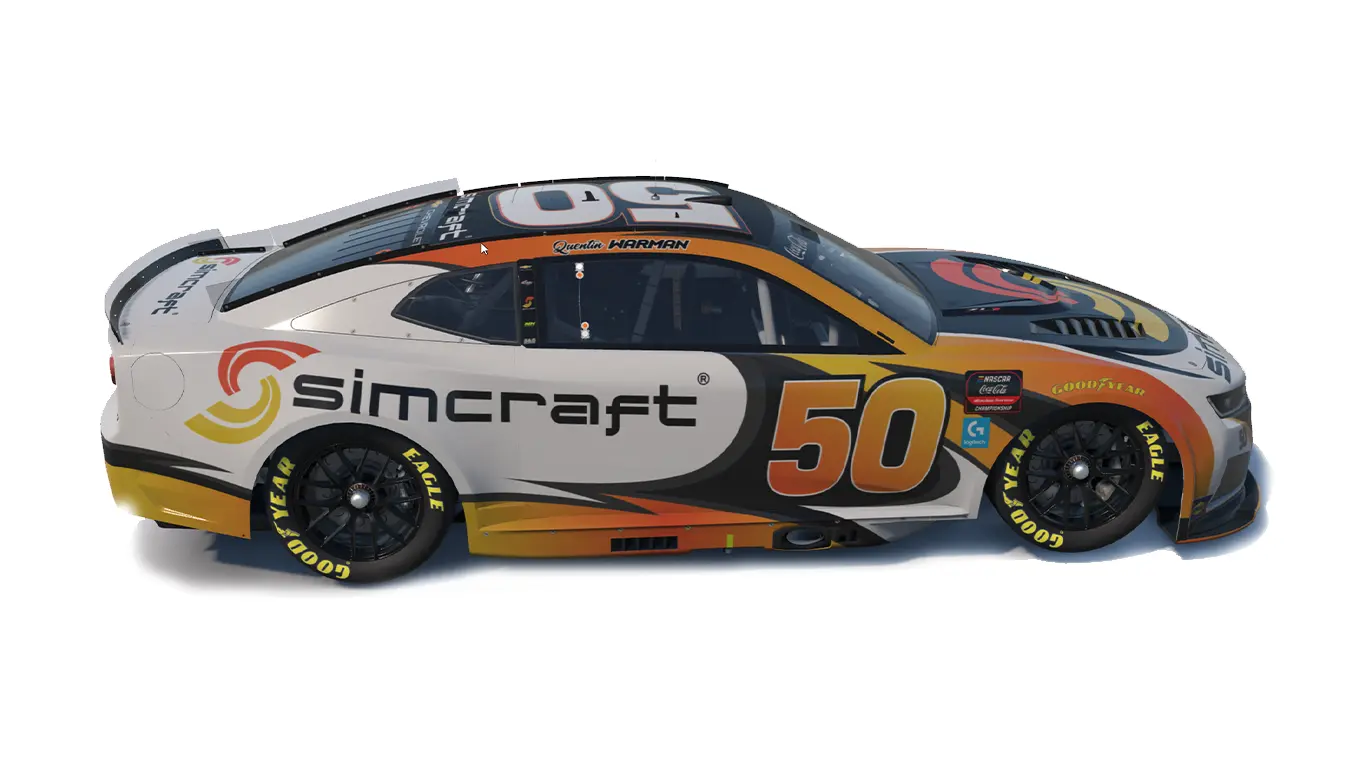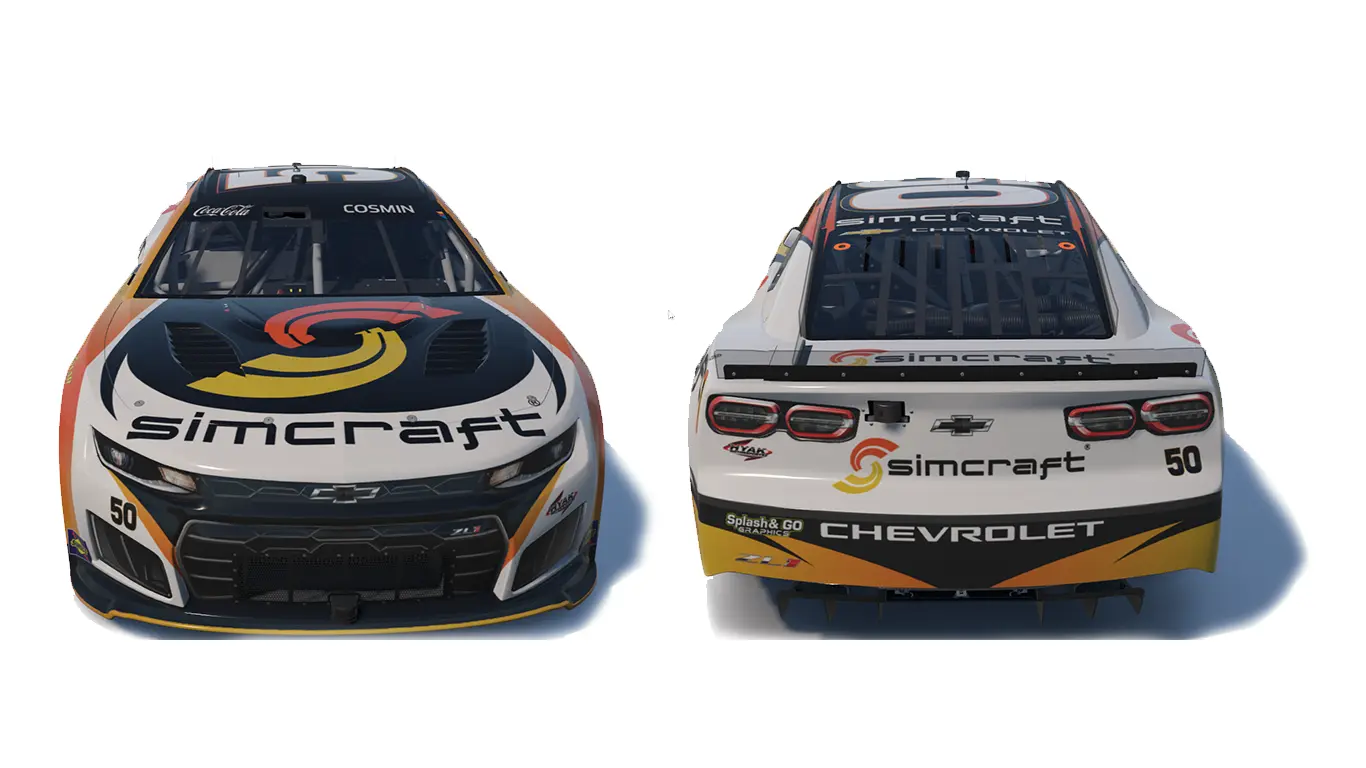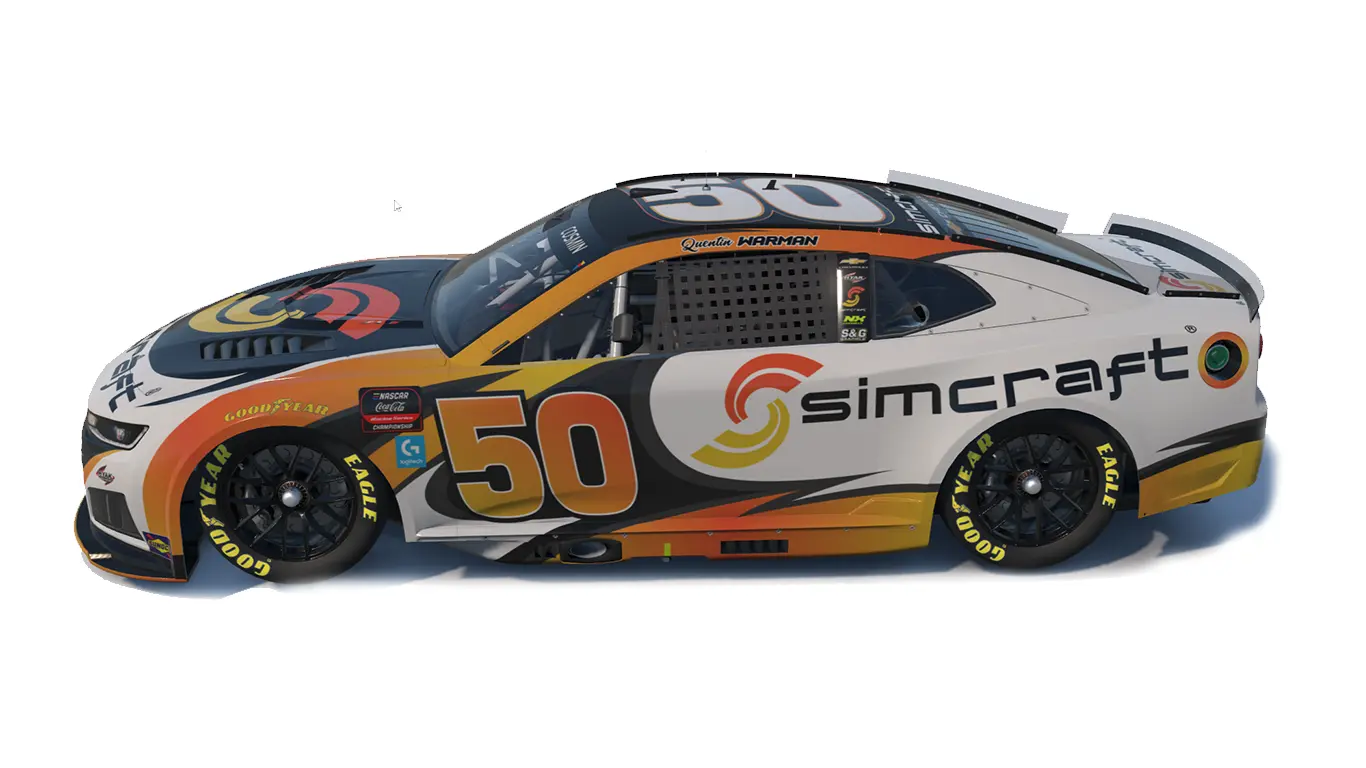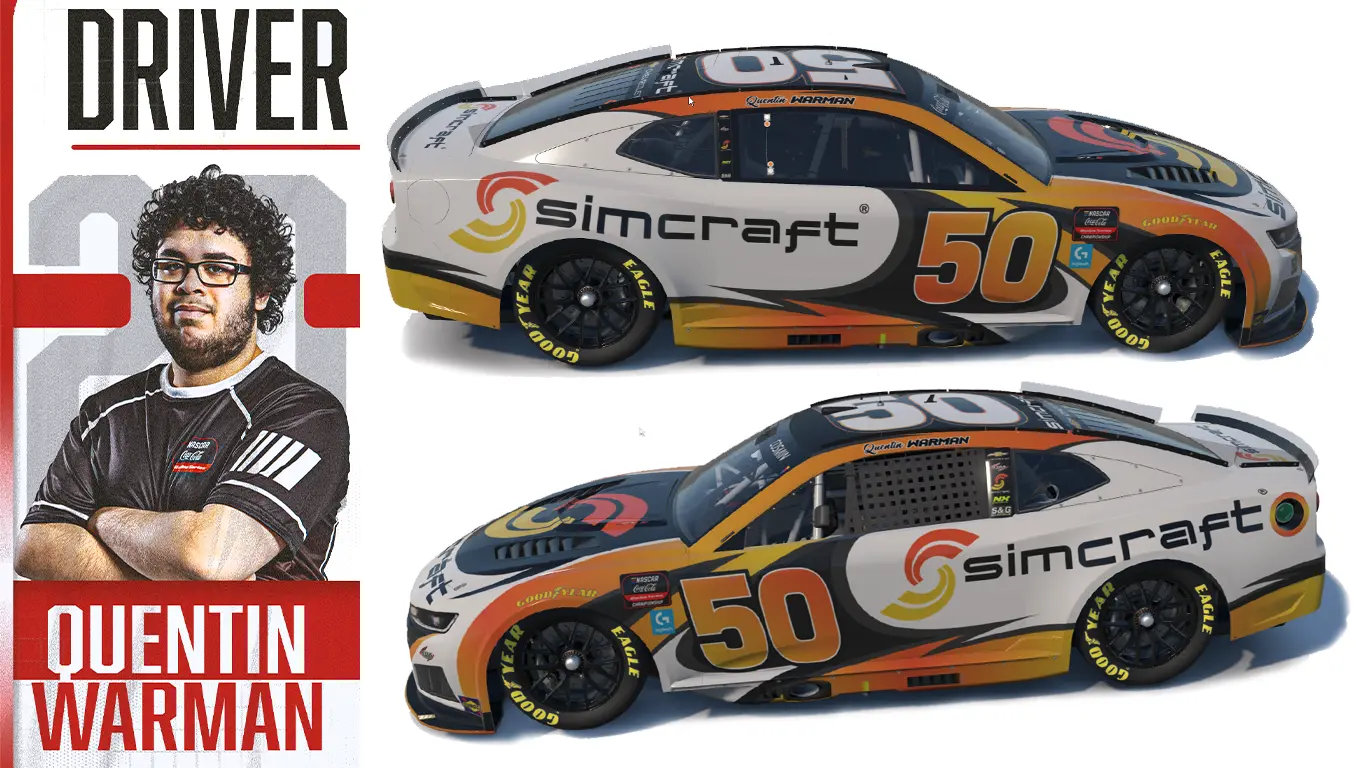
SimCraft is proud to renew our sponsorship of Hyak Motorsports for the 2026 eNASCAR Coca-Cola iRacing Series. Quentin Warman returns to the cockpit of the virtual #50 SimCraft Chevrolet, carrying our colors in the most-watched oval esports championship in the world. This is a brand partnership, plain and simple. It is also one of the cleanest demonstrations we have of what we actually are: the NASCAR simulator that real Cup Series teams use in their shops to dial in racecraft before the haulers leave for the track.
The eNASCAR Coca-Cola iRacing Series is the top rung of competitive virtual oval racing. Fields are routinely separated by thousandths in qualifying, and races are decided by a single overtime restart or a well-timed bump draft. Quentin brings serious talent and methodical preparation to Hyak Motorsports, and his car wearing SimCraft livery for a second season puts our brand in front of an audience that takes simulator technology seriously: race fans, engineers, OEM partners, and the working drivers who study every iRacing broadcast. See the entire 2026 schedule.
This is the visibility side of the story. The technology side is where it gets interesting.
What a NASCAR-Approved Simulator Actually Means
There are a lot of things people call a NASCAR simulator. Most of them are entertainment products with NASCAR-branded paint. Ours is the one that NASCAR itself formally approved for Driver-in-the-Loop use in the Cup Series under Section 13.5 of the rule book. That approval did not come from a press release. It came from a technical evaluation process that examined motion fidelity, vehicle dynamics accuracy, latency, and reliability in shop operations.
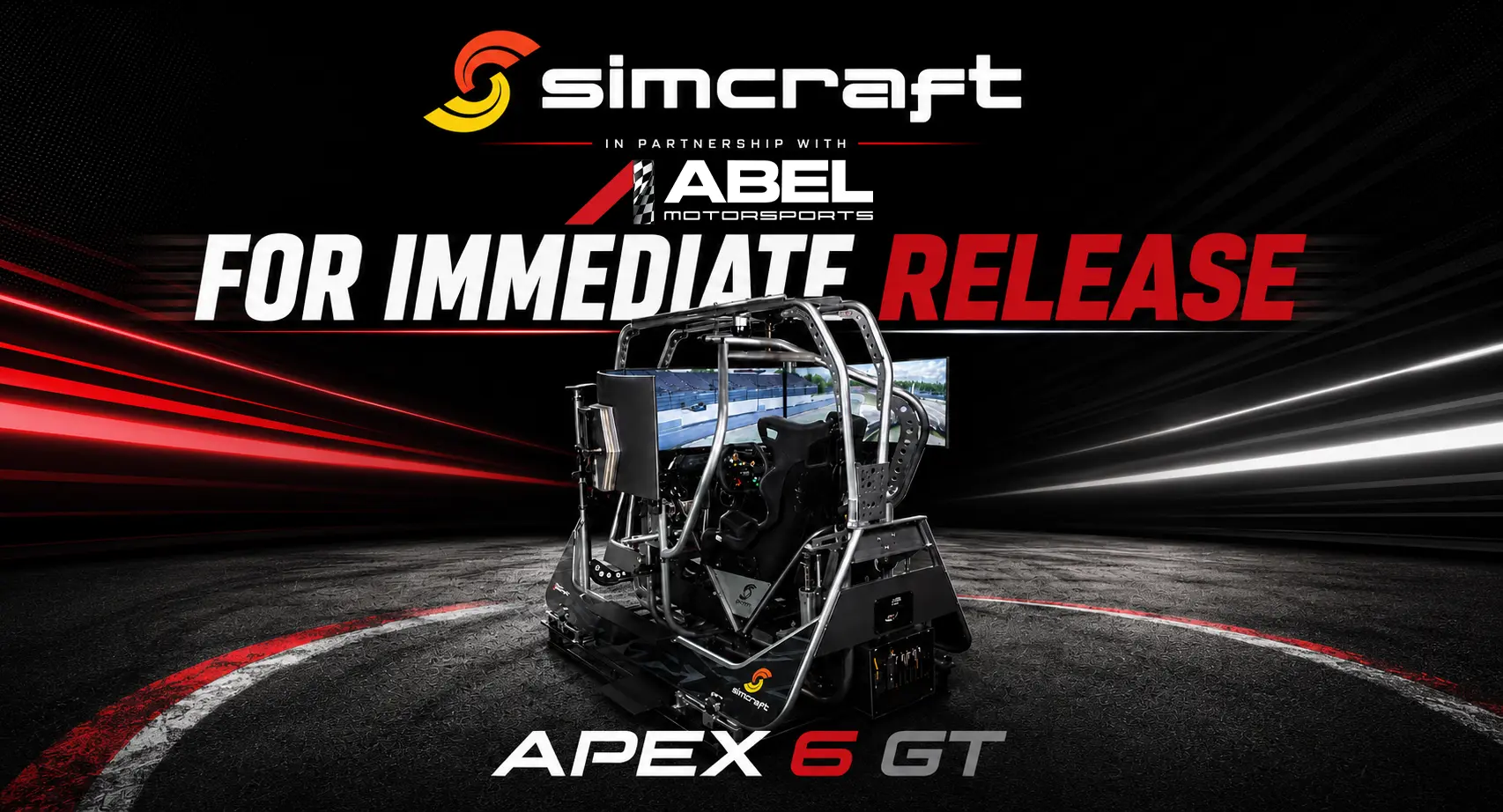
The APEX 6 GT cleared that process on January 10, 2025. Since then, it has earned a place in Cup Series race shops, where teams use it for in-shop preparation and vehicle development. The reason this approval matters is correlation. When an engineer makes a setup change in the simulator, the change has to behave the same way on track for the work to count. If it does not correlate, the seat time is worse than wasted: drivers practice instincts that betray them when the green flag drops.
After experiencing the SimCraft APEX 6, I was amazed by its realistic feel and immediately knew I was hooked. I was even left wondering how such authenticity was achieved, given that nothing else I’ve tried can match the real-world vehicle experience, regardless of price. SimCraft takes driver training and vehicle development to an entirely new level.
Jimmie Johnson, Co-Owner of Legacy Motor Club
A Sponsorship Built to Spotlight the Real-World Use Case
This is where the sponsorship and the engineering meet. Quentin is not running a SimCraft for his eNASCAR campaign. He is the on-screen face of our brand in eSports, and the #50 SimCraft Chevrolet livery is the badge that gets our story in front of the audience that should care most about it: the drivers, teams, and series that need a NASCAR simulator that delivers usable correlation in a real race shop.
When a fan, an engineer, or a team owner watches a Tuesday night iRacing broadcast and sees our colors at the front of the pack, the conversation that follows is the one we want them to have. They look up SimCraft, and what they find is a company building approved hardware for Cup teams, motorsport academies, and OEM driver development programs. The eNASCAR exposure is the headline. The Rule 13.5 approval and the Cup Series installations are the substance.
Six Degrees of Motion in a Full Motion Racing Simulator Built for Race Shops
The APEX 6 GT is the full motion racing simulator at the top of our commercial lineup. Six degrees of motion: roll, pitch, yaw, surge, sway, and heave. Mechanically and logically independent. Aligned mutually perpendicular and intersecting at the driver’s center of mass. That last detail is the one that separates a measurement tool from a thrill ride.
Most motion platforms on the market are seat movers or hexapods that translate the cockpit around an arbitrary geometric center, usually under the seat. The driver’s inner ear gets a pendulum sensation that does not match what the eyes see, which is the mechanical recipe for simulator sickness and false cueing. SimCraft motion happens around the same axis your body uses in a real car. When the rear steps out, the driver feels yaw first, exactly where they would feel it in the seat at Martinsville. The eyes and the inner ear agree, and the brain stops working overtime to reconcile them.
The technical specifications behind this approach are public on the SimCraft Motion Specifications page. The NASCAR-compliant configuration runs tighter rotational ranges than our standard spec, by design, to match the dynamics of a Cup car. Position resolution sits at 0.02 degrees. Latency is under one millisecond. Control frequency runs from 5 Hz up to 200 Hz. These numbers are why engineers trust it as a Driver-in-the-Loop instrument and not a video game accessory.
The Science of Driver Development with Motion Simulators
Approval is one thing. Outcomes are another. The science of driver development with motion simulators lives in the gap between visual processing and physical reaction. A driver who relies on visual cues alone is always reacting late, because the eyes register a slide after the body would have felt the load shift. Add accurate motion and the driver begins to anticipate the car instead of correcting it.
Research at the Spartan Motorsport Performance Laboratory at Michigan State University compared SimCraft to traditional seat-mover simulators and found that SimCraft produced superior lap-time progression, higher cognitive engagement, and physiological responses very close to actual race-car driving (Ferguson, 2023). That study is part of the same body of work that justifies the way Cup teams now schedule simulator hours alongside wind-tunnel time and CFD sessions.
The point of all this is not that simulators replace track time. The point is that an approved NASCAR simulator gives a team a repeatable environment to test setup changes, train new drivers, and prepare for tracks that the calendar does not allow time to physically visit. Tire models evolve, aero rules change, schedules tighten. The shops that win the most are the ones whose simulators correlate.
Three Editions, Three Entry Points
We build our racing simulators in three editions to match how teams and individuals actually budget for this kind of capability.
BUILDER ships as an assembled motion chassis with our core technology and software, crated for the buyer’s own integration work. It is the lowest-cost entry into real SimCraft motion.
STANDARD is turn-key, with full assembly, configuration, factory testing, on-site setup, driver training, and multi-year technical support.
ELITE is the same turn-key delivery built around our highest-grade structural materials and components, intended for facilities that run high-utilization training programs.
For teams or facilities that need a smaller footprint, the compact motion racing simulator APEX CT delivers core SimCraft motion in a 5′ x 5′ space with up to four degrees of freedom. For esports programs and entry-level driver development, our esports motion racing simulator GRID1 brings yaw-based motion to a 3′ x 4.5′ footprint.
White-Glove Installation Is the Other Half of the Product
We do not ship a NASCAR simulator in a crate and trust the customer to make it perform like the systems at Legacy Motor Club. Every STANDARD and ELITE delivery includes white-glove installation handled by SimCraft technicians who know both the hardware and the racecraft. The visit covers uncrating, mechanical assembly, motion calibration across all degrees of freedom, force-feedback tuning, software-stack optimization for iRacing or whatever title the team runs, and an on-the-wheel walkthrough with the driver before the team leaves.
That is the difference between an installed simulator and a calibrated one. Misaligned motion teaches the wrong reflexes. A misconfigured force-feedback profile creates false steering loads that the driver then learns to correct against, until the same correction shows up in a real car and costs them a corner. Our install team prevents that by tuning the system to the discipline, the vehicle class, and the driver in front of them.
Why the Hyak Motorsports Sponsorship Matters Beyond Race Night
Every time the #50 SimCraft Chevrolet shows up on an eNASCAR broadcast, a few things happen. Sim racers see a brand they recognize from social media and YouTube. Working drivers see a brand their peers in Cup, Xfinity, and Truck shops are already using. Engineers see a brand attached to a Section 13.5 approval. Decision-makers at OEMs, academies, and team operations see all three at once.
That convergence is the entire point of the sponsorship. We are not asking anyone to believe a young eNASCAR driver wins because of our hardware. We are asking the audience to look closer at the company whose colors he carries, and to recognize what is actually happening in the Cup garage: real drivers, on real schedules, using a real NASCAR simulator to refine the racecraft that decides Sunday afternoons.
Our partnership with Hyak Motorsports gives us a high-visibility stage. The Rule 13.5 approval gives us the technical credibility to back it up. Wherever you sit on the ladder, from a sim racer building a home setup to a Cup crew chief evaluating shop tools, the conversation is the same. Talk to us when you are ready to make seat time count. Talk with a SimCraft specialist today.
FAQ - About Our NASCAR Simulator and the Hyak Motorsports Sponsorship
Is Quentin Warman racing on a SimCraft for the 2026 eNASCAR season?
No. The Hyak Motorsports relationship is a brand sponsorship. Quentin pilots the virtual #50 SimCraft Chevrolet in the eNASCAR Coca-Cola iRacing Series, which puts our livery in front of millions of viewers across the season. Our racing simulators are used by Cup Series teams, racing academies, and OEM programs for real-world driver development, not by individual eNASCAR competitors as part of this sponsorship.
What makes an officially approved NASCAR simulator different from a high-end consumer setup?
Approval under Section 13.5 of the NASCAR rule book is a technical compliance threshold. The APEX 6 GT cleared an evaluation process that measured motion fidelity, vehicle-dynamics accuracy, latency, and reliability for Driver-in-the-Loop use in shop operations. A consumer setup, even a high-end one, treats motion as a thrill feature. An approved NASCAR simulator treats motion as a measurement tool that engineers and drivers can correlate to track data.
Which real-world race teams use the APEX 6 GT?
Legacy Motor Club deployed the first NASCAR-approved APEX 6 GT in 2025 for use by Jimmie Johnson and the team’s driver development program. Alpha Prime Racing in the NASCAR Xfinity Series, Riley Technologies in IMSA, Wayne Taylor Racing, and Skip Barber Racing School are among the programs using SimCraft hardware. A broader list of professional users is documented on our Champions’ Testimonials page.
How does center-of-mass motion technology reduce simulator sickness?
Simulator sickness comes from a mismatch between what the eyes see and what the inner ear feels. Most motion platforms move the cockpit around a geometric center that does not match the driver’s body, which produces false cues. SimCraft controls roll, pitch, and yaw independently around the driver’s actual center of mass, with surge, sway, and heave translation aligned to the same point. The visual horizon and the physical motion stay in agreement, which lets drivers stay in the seat for sustained development sessions rather than 20-minute demo laps.
Can a NASCAR simulator run software other than iRacing?
Yes. SimCraft systems are software-agnostic. iRacing, Assetto Corsa Competizione, rFactor, and proprietary team-developed physics models are all supported. Every STANDARD and ELITE delivery includes integration with the customer’s chosen software stack and ongoing technical support, regardless of which title the team runs.