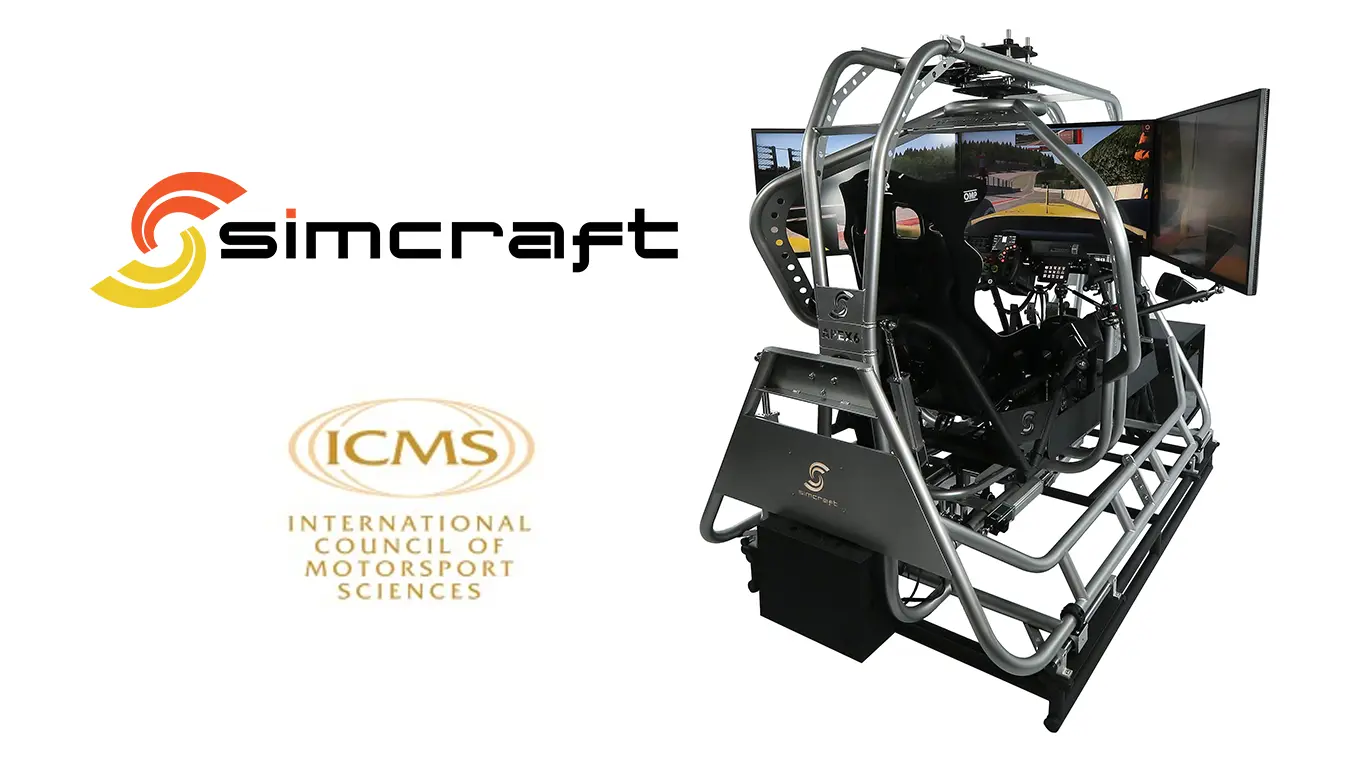
Motorsport pushes the machine and the human to the edge. What happens off the track now matters as much as the strategy on it. SimCraft is proud to formalize a partnership with the International Council of Motorsport Sciences (ICMS) to advance the science of driver development with motion simulators through quantitative validation, clinical research, and motorsport-grade engineering. This alliance puts SimCraft alongside medical professionals, sport scientists, and engineers committed to one outcome: turning the simulator into a real laboratory for human performance.
Why This Partnership Matters for Motorsport
For years, virtual recreation chased graphics and wheel feel. The driver’s biology in the cockpit was secondary. By formalizing a relationship with the ICMS, the focus shifts to clinical and neurological validation. Researchers can study the exact toll high-speed cornering takes on a driver’s body and mind, with data that holds up to peer review.
A driver inside a full motion racing simulator experiences every millisecond of rotational displacement. Stationary setups mislead the brain, opening a gap between what the eyes see and what the body feels. That gap builds bad habits and slows real skill acquisition. Joint work between SimCraft engineers and ICMS clinicians ensures every pitch, roll, and yaw movement matches the telemetry recorded on real circuits.
Sanctioning bodies like NASCAR, F1, IMSA, and IndyCar keep refining their medical standards. Validated data from a physics-correct motion platform gives them an objective look at human tolerance during long stints. Virtual training is becoming a true medical twin to real track operations.
Physics-Correct™ Motion, Not Programmed Tricks
Many consumer setups rely on lookup tables that fire preset vibrations based on in-game events. SimCraft does it differently. Real-time physics telemetry translates into actual rotational and linear displacement. When the car hits an off-camber corner or a rough curb, the cockpit moves the way the math says it should, around the vehicle’s center of mass.
That precise translation lets coaches read clean data points: steering velocity, brake pressure modulation, throttle smoothness. The driver’s responses are largely subconscious. Elite operators feel the rear tires let go through the inner ear long before the eyes catch the slide. Replicating that requires mechanical hardware free of lag or artificial exaggeration.
A proper motion cueing algorithm sits at the core of all of it. This cueing engine takes complex digital telemetry and turns it into physical displacement within a finite envelope. Generic filters cause lag or unrealistic counter-movement, which worsens vestibular conflict. A clean algorithm prioritizes onset acceleration, giving the body the initial sensation of a turn or braking event, then quietly resetting without the driver noticing.
When motion cueing is right, the otolith organs and semicircular canals in the inner ear read displacement just like they would in a real cockpit. The payoff: longer practice sessions, fewer cases of simulator sickness, and authentic muscle memory.
Quantitative Validation Through a Professional Racing Simulator
A professional racing simulator is a laboratory. Every input can be isolated, scrutinized, and repeated. By syncing simulator motion to the physics engine, engineers measure exactly how a driver manages weight transfer and tire compliance. Ambient temperature, track degradation, and tire wear stay perfectly controlled, so the only variable is the human.
Teams use this for new vehicle development without burning fuel or tires. An engineer can change virtual suspension geometry on a specific car, and the driver evaluates the change in minutes with telemetry to back it up. This integration of driver perception and mechanical metrics shortens the engineering loop, so teams can isolate whether a loss of pace is a setup issue or driver fatigue. Manufacturers save time and money optimizing setups before a physical prototype exists.
The same approach changes how teams scout young prospects. Instead of subjective reports, management studies how a prospect reacts to sudden balance shifts and changing track conditions over a long run. The data offers an unbiased view of technical proficiency. The driver development pipeline gets built on verified competency rather than guesswork.
Cognitive Load and Driver Behavior Under Stress
The human brain at racing speeds is doing the work of a tactical fighter pilot. Hundreds of sensory inputs per second, fine motor control over the steering wheel and pedals, predictive planning all at once. If the synthetic environment cannot replicate the physical sensations of travel, the brain fills in the gaps and mental fatigue accelerates.
Top drivers do not rely on what they see through the visor alone. They rely on somatosensory feedback, feeling velocity changes through the musculoskeletal system. Without accurate physical displacement, the driver leans on vision only, and reaction times slip. Realistic physical workloads in a controlled environment let teams systematically build cognitive endurance, the kind that holds up at hour eight of a Petit Le Mans stint.
Static setups also distort driver behavior. With no physical consequence, the driver knows there is no real risk, and decision-making turns unrealistic. Add accurate physical feedback and survival instincts engage naturally. Sport scientists can analyze authentic driving behavior under stress: how anxiety affects braking consistency, how steering smoothness changes when traffic closes in. Heart rate variability, respiration, and EEG round out the picture.
That kind of research has been part of SimCraft’s work for years. Independent studies, including those by Dr. David Ferguson at the Spartan Motorsport Performance Lab at Michigan State University, have shown that drivers on a SimCraft motion simulator maintain concentration and attention through a long stint, while seat-mover platforms produce measurable drops in both. The ICMS partnership formalizes and expands that research across more disciplines.
Visual Tracking Inside a High-Fidelity Driving Simulator
Visual processing is the foundation of high-speed control. A driver looking through a corner relies on optic flow to gauge speed and trajectory. If the display fails to align with physical motion, peripheral vision suffers, depth perception degrades, and apexes get missed.
Inside a high-fidelity driving simulator, visuals and motion work in lockstep. Elite drivers scan far down the track, processing peripheral information subconsciously. A premium platform builds that habit by keeping the horizon in perfect agreement with chassis dynamics. When the driver returns to the real circuit, visual tracking stays stable through elevation changes and high-speed corners.
This level of immersion is why sim racing provides such a productive pathway for modern driver development. Teams log hundreds of practice miles in a controlled environment instead of burning track rental and consumables. Drivers learn visual markers and geometric lines for a new circuit before they ever turn a wheel on real tarmac. Beyond performance, advanced driving simulators give medical staff a way to evaluate visual deficits caused by fatigue or minor injury, well before they show up as on-track errors.
Standardizing Research Across Driving Simulators
Without strict standards, different platforms produce wildly inconsistent data. A standardized scientific baseline is what turns driving simulators from practice tools into real research instruments. That standard is a core focus of the SimCraft and ICMS partnership, with validated testing protocols that benefit the entire racing industry.
The framework matters for integrated driver development programs that grow young talent over years. When a driver moves up through the tiers, a consistent baseline lets coaches measure long-term growth honestly. Eliminating mechanical variance lets sport scientists isolate human performance with confidence.
It also matters for manufacturers running simulator development on next-generation cars. A validated motion environment delivers what some have called only true spec racing analysis in a virtual space. Every physical force is rendered accurately, every metric tracked precisely. The line between virtual testing and real track testing gets thinner with every iteration.
Where Medicine Meets Motorsport
Advanced simulators are now proving useful in rehabilitation and recovery. When a racer suffers a fracture or a concussion, the road back to the grid is long. Traditional therapy restores strength and mobility, but it cannot replicate the high-G environment of a real cockpit. A sophisticated motion simulator bridges that gap.
For a driver recovering from a traumatic brain injury, retraining visual tracking and vestibular integration is essential to clearance. A physics-correct motion platform introduces realistic sensory workloads in a safe space. If the driver can manage an intense virtual stint without headaches or disorientation, medical staff have something objective to inform return-to-race decisions.
SimCraft’s work on neurodegenerative disease rehabilitation with the Austin Hatcher Foundation and the University of Tennessee College of Medicine showed the same principle in a different setting: physics-correct motion can drive measurable cognitive improvement. The motion effects that make a driver faster on track also help patients with cognitive control deficits. The ICMS partnership pulls those threads together into one motorsport-focused research program.
Why SimCraft, Why Now
SimCraft already powers the NASCAR Cup Series under Section 13.5, the official NASCAR simulator approval few other systems hold. Skip Barber Racing School, Riley Technologies, Alpha Prime Racing, and the Indianapolis Motor Speedway Museum all run SimCraft platforms for training, R&D, and public engagement.
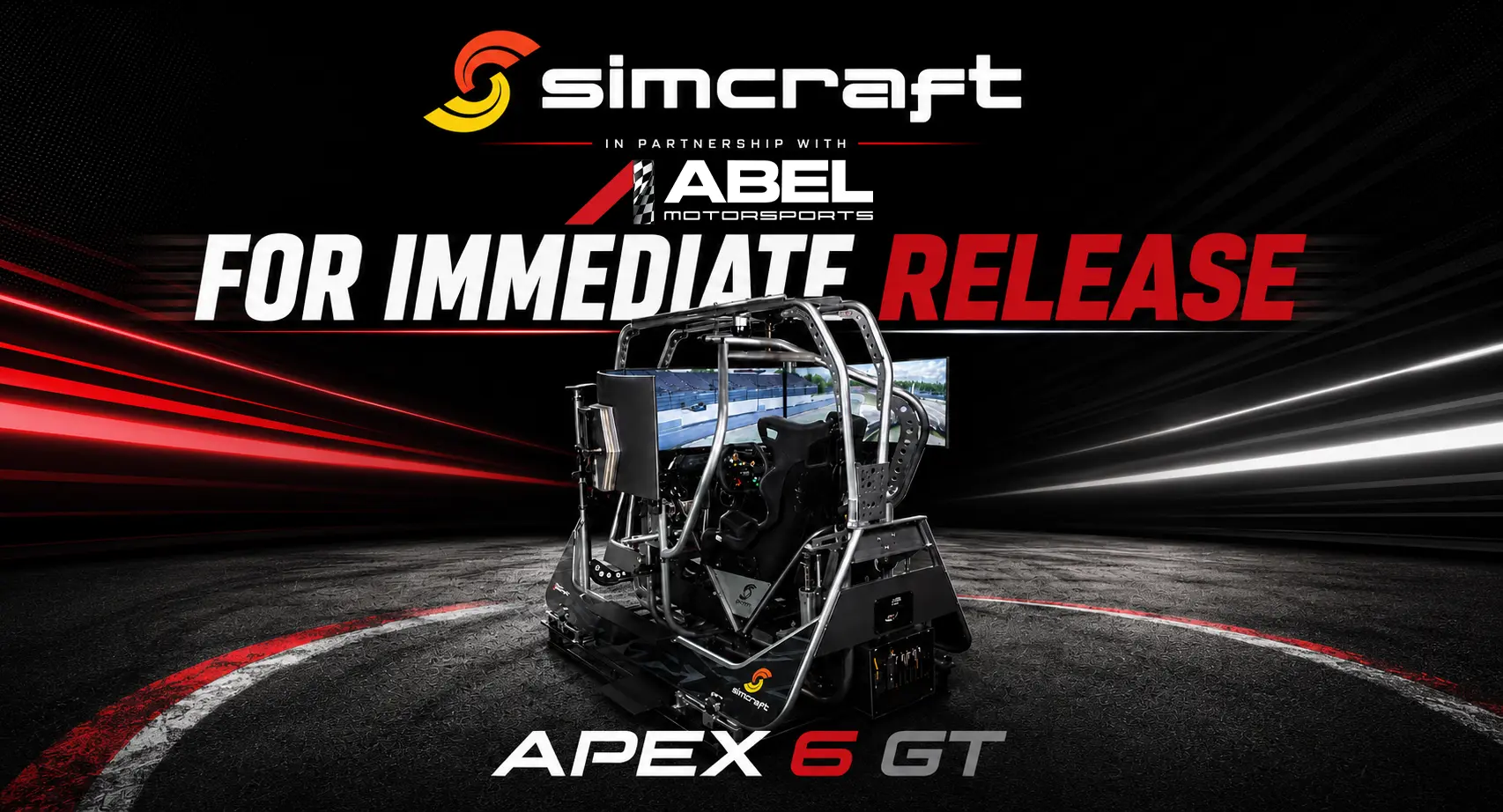
The product line covers the full range. The APEX 6 GT is a full motion racing simulator used by NASCAR Cup teams. The APEX CT is a compact motion racing simulator for tighter rooms. The GRID1 is an esports motion racing simulator with independent yaw, used everywhere from karting prep to museum installations. Every system is engineered, built, and supported in Kennesaw, Georgia, with white-glove installation handled by SimCraft technicians who race, tune, and support the hardware on-site.
The partnership with ICMS is a natural extension of that DNA. Validated research, clinical insight, and engineering fidelity now sit at one table. The result will benefit drivers, engineers, sanctioning bodies, and the patients and athletes who depend on this technology far beyond the racetrack. Optimal driver development now has a scientific home.
Ready to see what physics-correct motion does for your training, your team, or your research program? Connect with SimCraft directly.
FAQ
What does the SimCraft and ICMS partnership change about racing simulators?
The collaboration grounds simulator development in peer-reviewed science. Engineering decisions get checked against human physiology, vestibular response, and cognitive load research, so the resulting platforms deliver clinical-grade fidelity for both training and medical applications.
Why is full motion important for professional driver development?
A full motion racing simulator delivers onset accelerations and chassis displacement that stationary setups cannot replicate. Those physical cues are essential for authentic muscle memory and vestibular integration, so drivers learn traction limits the same way they would on a real track
What makes physics-based motion better than canned effects?
Physics-based systems convert live telemetry into precise mechanical displacement instead of triggering preset vibrations. The physical motion matches the visuals, sensory conflict drops, and practice sessions stay productive for longer.
Can a compact motion racing simulator deliver the same research value?
Yes. A compact motion racing simulator built on the same core principles delivers high-fidelity rotational cues in a smaller footprint, giving independent drivers and smaller teams access to scientifically validated tools without losing accuracy.
How does a NASCAR simulator help with vehicle development?
A validated NASCAR simulator lets engineers test chassis settings, suspension geometry, and aerodynamic balance in a repeatable virtual environment. Test cycles compress, costs drop, and the data correlates directly with real-world track testing.