Professional open-wheel programs run on a tight margin. A few hundredths of a second separates a pole from a third row start, and the budget that buys those hundredths is finite. So when a serious INDY NXT team decides where to put its development dollars, the choice gets scrutinized hard. More of those teams are landing on the same answer: a center of mass motion platform that puts factory-level fidelity in reach without the factory-level invoice.
Download the Press Release Here.
Rather listen than read? We've got you covered.
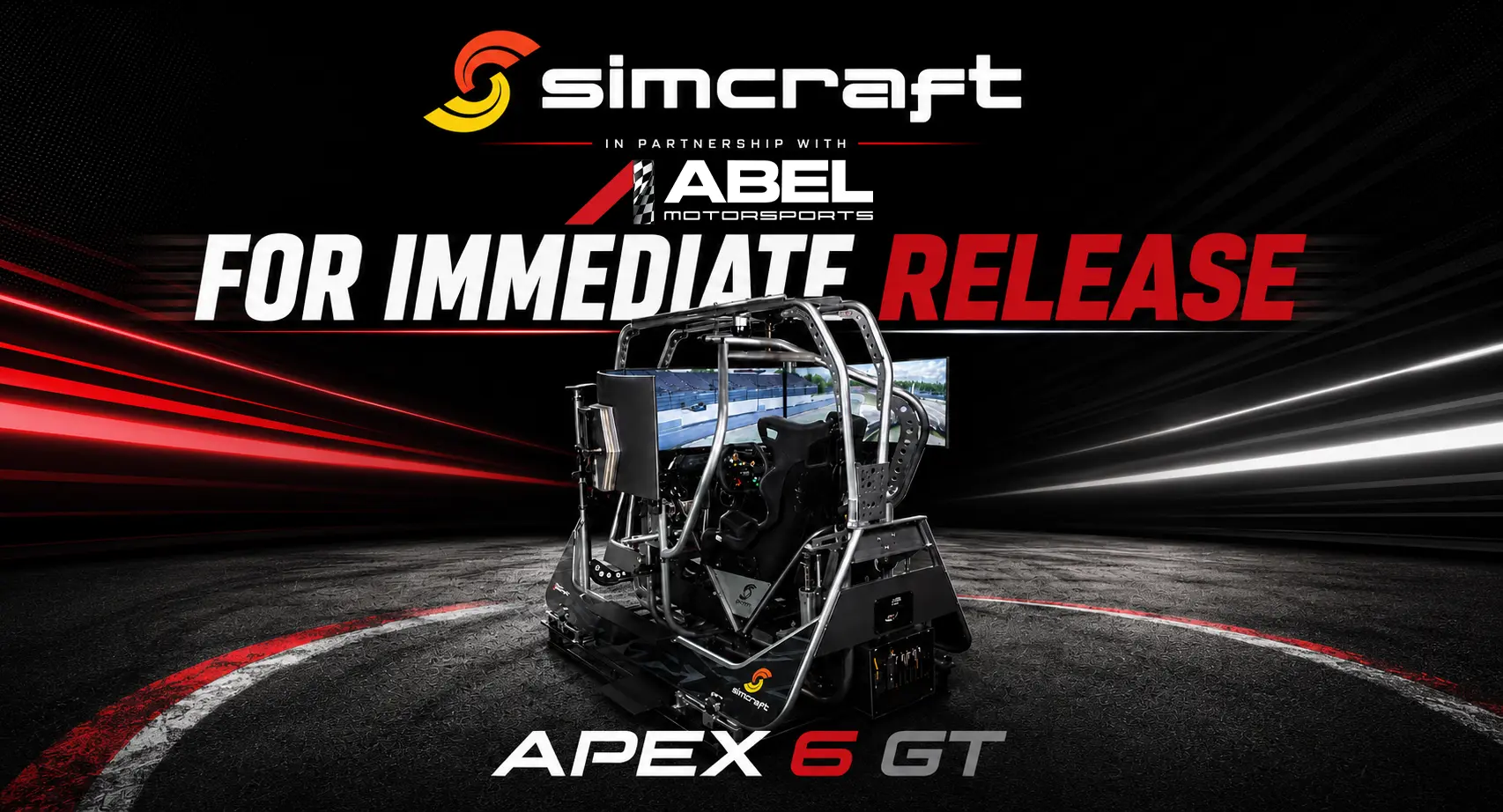
That shift says something. For years the assumption was that high-end driver-in-the-loop work belonged to the manufacturers, locked behind seven-figure hardware and proprietary software. Abel Motorsports tested that assumption when it built out its 2026 racing program, and the conclusion was clear enough that the team made the SimCraft APEX 6 GT the center of its preparation effort. Here is the technical and financial reasoning behind why pro teams keep arriving at the same decision.
Built for Driver Development, Not a Generic Motion System
A simulator earns its place in a race shop only if the cues it sends match the vehicle. That sounds obvious, but most motion hardware fails it. The platform moves the driver in ways a real vehicle never would, and the body learns the wrong lesson. Over a season of repetition, that builds reflexes that work against the driver when it counts.
The APEX 6 GT was designed around the opposite principle. Every motion cue traces back to how a real vehicle loads and unloads through a corner. The goal is correct muscle memory, the kind that transfers cleanly from the seat in the shop to the cockpit at the circuit. A racing driver who runs a hundred laps of a layout in this environment arrives on event weekend already knowing the braking points, the curbing, and the way the machine rotates at the apex.
That is the difference between a real training tool and an expensive distraction. SimCraft’s racing simulators are tuned for development first, and the engineering that follows all serves that single aim. For a team in the business of racing, nothing else justifies the floor space.
How Independent 6DOF Changes the Feel
Here is the part that mattered most to the engineers who evaluated the platform.
Most high-end movers are built on hexapod technology. Six actuators push against one shared platform, so the degrees of freedom blend together and work against each other. The body feels a smeared, averaged version of motion that no real vehicle produces. For a racer chasing the limit, that is worse than a static seat, because it teaches false instincts that have to be unlearned at the circuit.
SimCraft works differently. The APEX 6 GT is a center of mass system that moves all six degrees of freedom independently and relatively. Roll, pitch, yaw, surge, sway, and heave each respond on their own, the way a real chassis behaves under load. The platform physically moves the seat around the driver’s true center of mass, so the cues line up with the vehicle instead of fighting it. This is the heart of rigid body motion, and it is why the 6DOF response feels like driving rather than being shoved around.
Just as important, the screens and the seat travel together as one cockpit. On a hexapod with fixed monitors, the eyes stay locked in place while the platform moves the body, and that conflict between what a driver sees and what a driver feels produces false cues and fatigue. In a SimCraft, the whole cockpit moves as a unit, so vision and motion agree. Drivers report it as the most accurate, realistic motion they have experienced, and it is what they lean on when learning a new layout.
Software Freedom That Fits the Way You Already Work
A platform is only useful if it fits the way a team already works. Plenty of factory movers force a program onto their software, their data formats, and their service schedule. That friction costs time no racing operation can spare.
The SimCraft motion system runs with whatever a team already uses. iRacing, Assetto Corsa, and custom engineering software all drive the same hardware. A chief mechanic and race engineers do not have to relearn their tools or rebuild a setup library from scratch. The wheel, the controls, and the pedals they already trust carry straight over. They plug in, push a button, and they are running laps. The hardware adapts to the team, not the other way around.
That openness is part of why a racing simulator of this caliber slots into a pro program without disruption. SimCraft handles delivery and white-glove installation at the shop, so the system is dialed in and ready before anyone sits in it. The first session is a working session, not a setup headache. Even the smallest controls and adjustments come pre-configured for the way a competitive team operates. For a racing simulator to matter at this level, it has to disappear into the routine, and this one does. A team treats the motion simulator the way it treats any other piece of racing equipment: a fixed part of the weekly rhythm, ready the moment a driver walks in.
How a Motion Simulator Pays for Itself in Seat Time
Real seat time at the circuit is the most expensive resource in racing, and it is the one most teams cannot buy enough of. Tires, fuel, transport, crew hours, and the very real risk to a six-figure car stack up every weekend. Every lap a driver banks in the shop is a lap the team does not pay for at speed.
The math is what makes the decision straightforward. A single INDY NXT season runs roughly $1.8 million, and an hour of real on-circuit running costs over $54,000 once everything is counted. Against that number, an APEX 6 GT ELITE pays for itself in about three hours of equivalent seat time. After that, the platform turns unlimited, repeatable practice into a fixed cost. A racing driver can run one corner two hundred times before an event weekend. Engineers can validate a setup change before it ever touches the real machine.
The value framing scales from there. For the price of a single seven-figure OEM system, a team could equip as many as ten people with individual APEX 6 GT ELITE units. That is a seat for each driver, engineer, and crew chief, instead of one shared motion simulator the whole program has to queue for. The science of driver development with motion simulators backs the approach: correct cues build correct muscle memory, and that translates straight to lap time. You can see how that return is calculated in our breakdown of the racing simulator cost savings that drive the math, where the numbers favor the simulator faster than most teams expect.
Performance Motion Across Four Jobs Every Week
A pro team does not buy a single-purpose tool. The APEX 6 GT goes to work across the whole program, which is where the performance motion architecture earns back its cost several times over.
The first job is driver development, building confidence and car control in a true center of mass environment. The second is preparation, learning every layout on the calendar before the team arrives. The third is engineering, validating setup direction with repeatable, physics-correct™ data the engineers can trust. The fourth is recovery, keeping racing talent sharp and rehearsing race scenarios between events.
Because the cockpit and screens move as one and the cues match the real thing, every one of those jobs benefits from the same accurate motion. The platform is not compromised for one use at the expense of another. It does driver work in the morning and engineering work in the afternoon on the same hardware. For a growing racing operation, that versatility is what turns a single purchase into a program-wide asset rather than a one-driver luxury.
Why This Platform Was Designed for Pro Teams
Approval matters in professional motorsport, because a team is trusting its entire preparation to the tool. The same APEX 6 GT is approved as a NASCAR simulator for Cup Series teams under the driver-in-the-loop rules, the same standard demanded across NASCAR and IMSA competition. That sanctioning approval is part of why teams trust the platform before they ever sign off on it.
The result is a racing sim that pro programs can build around with confidence. From drivers to engineers, everyone trains in the same environment, on the same data, week in and week out. That consistency is hard to overstate. When a driver and an engineer are reading from the same repeatable platform, their feedback finally speaks the same language, and setup direction stops being a guessing game.
That combination, professional motion fidelity, software freedom, and economics that hold up, is why Abel Motorsports chose to go racing with SimCraft. Team Principal John Brunner put it plainly when the program was announced.
We’re extremely excited to bring the APEX 6 GT into our program. As we continue to grow in INDY NXT, having a true driver-in-the-loop platform of this caliber lets us sharpen driver training, accelerate setup development, and give our engineers and chief mechanic a repeatable environment to work problems before we ever get to the track. John Brunner, Team Principal, Abel Motorsports
It is the same conclusion teams across INDY NXT, NASCAR, and IMSA keep reaching once they put the platform through its paces. You can see the broader pattern in our Choice of Champions record and across the programs that have made the same call.
A simulator that moves correctly, fits an existing workflow, and pays for itself in a handful of seat-time hours is not a luxury for a growing program. It is the most efficient development dollar a pro racing team can spend, and that is why the choice keeps coming up the same way. The teams winning the close ones are the teams who practiced the close ones first.
That is the quiet advantage a serious racing simulator hands a program. The hours nobody sees, banked in the shop, are the hours that show up on the timing screen. A pro racing team that treats its motion simulator as core infrastructure rather than a novelty builds a measurable edge over a full season, one corner and one setup decision at a time. When a motion simulator does its job, the whole racing program gets quicker, not just one driver, and that compounding gain is exactly what separates a contender from the rest of the field by season’s end.
Frequently Asked Questions
What makes the APEX 6 GT different from a hexapod simulator?
A hexapod blends all six degrees of freedom through six shared actuators, which can teach the body movement a real machine never makes. The APEX 6 GT moves each degree of freedom independently around the driver’s center of mass, so the motion cues match real vehicle behavior and build correct muscle memory.
Does the APEX 6 GT work with existing sim software?
Yes. The SimCraft system is compatible with iRacing, Assetto Corsa, and custom engineering software, so teams keep their current tools and data without being locked into a proprietary ecosystem. The wheel and controls a team already runs carry straight over.
How does a motion platform save a race team money?
Real seat time is extremely expensive once tires, fuel, transport, and risk to the vehicle are counted. A high-level platform turns repeatable practice into a fixed cost and can pay for itself in only a few hours of equivalent on-circuit running, after which every banked lap is essentially free.
Why do the screens move with the seat?
When monitors stay fixed and only the platform moves, what a driver sees and feels conflict, which creates false cues and fatigue. In a SimCraft, the screens and seat travel as one cockpit, so vision and motion agree and the feel stays accurate through long sessions.